
3122
Non-isolated on-board-charger for electric and hybrid electric vehicles
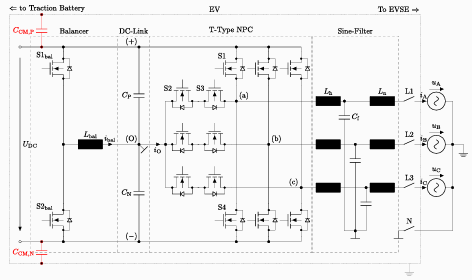
Today, On-Board-Chargers are usually realized as a two-stage design consisting of an active frontend and an isolated DC/DC-converter. The second stage is mostly needed to avoid residual currents that would trip the residual current protective device (RCD). This comes at the cost that during conversion, the electric energy will have to pass through two powerelectronic converters, each producing losses and reducing efficiency.
Subject area
Lab forPower Electronics and Control ofDrives
Patent number
DE102023119518
Contact person
Prof. Gerd Griepentrog
gerd.griepentrog@lea.tu-darmstadt.de
+49 6151 16-20580
Downloads
Lorem ipsum dolor sit amet, consetetur sadipscing elitr, sed diam nonumy eirmod tempor invidunt ut labore et dolore.
Optionale Headline
This problem can be tackled by using a 3-level-active frontend together with a specialized modulation technique. This reduces the residual currents to an acceptable level. The technology can be used in single-phase or three-phase mode and covers the entire voltage range of common 800V battery packs. By eliminating the second converter stage, the power loss during charging is significantly reduced, thus leading to improved vehicle efficiency, reduced energy cost and a reduction of the ecologic impact of electric and hybrid mobility.