A collaborative teaching project by TU Darmstadt and Hochschule RheinMain brings research and business together
How does excellent research turn into a viable business model? An unusual cross-university collaboration between TU Darmstadt and Hochschule RheinMain brings students, researchers—and patents—to the same table. In a newly developed course format, Master’s students in Business Management work on real Deep Tech inventions. The ambition is high, the path complex—and that’s exactly what makes it such a powerful learning experience. This is a story about translation work between lab and market.
The former Senate Hall of TU Darmstadt isn’t a place for improvisation: bare walls, windows on three sides, harsh fluorescent light. Anna Marie Brehm sits with her team in the second row along the wall, hands clasped. Next to her: Ferhat Caner. Three, maybe four hours of sleep. “My nerves were already kicking in,” Ferhat says later, laughing as if the shaking has somehow transformed into pride and relief. “But we crushed it.”
It’s Pitch Day. Seven marketing teams present business models built around real research projects. For Anna Marie Brehm and Ferhat Caner, it’s the first pitch of their lives. And the topic is anything but familiar: printed, vascularized organ-on-chip systems for pharmaceutical research. Fundamental science—far from the typical case study in a marketing textbook.
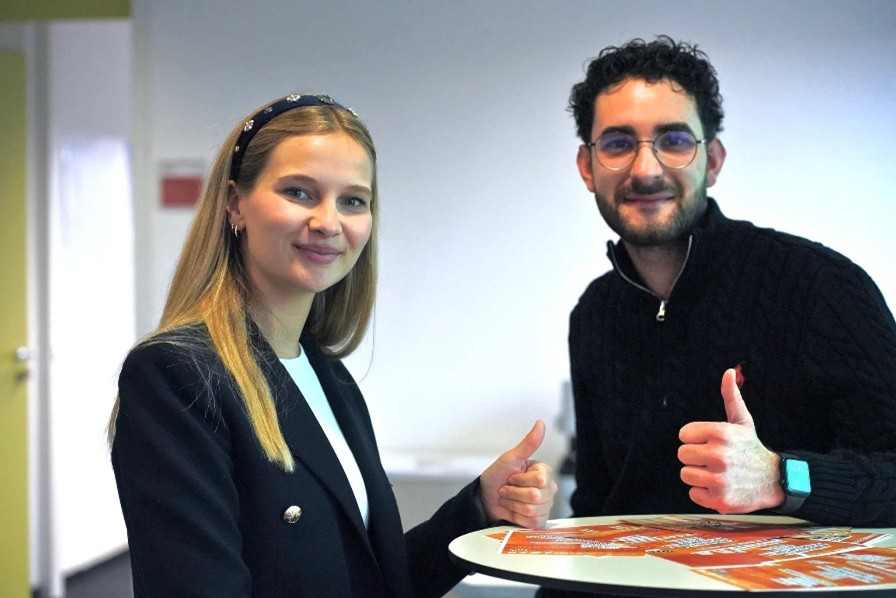
Anna Marie Brehm & Ferhat Caner, Master’s students in Digital Business Management / Photo: Heike Jüngst
“We were told: TU provides the technology—and we turn it into a business model you could actually build a start-up on,” Brehm says. No imaginary markets, no made-up numbers—just real research, real uncertainties, real constraints. “At first, honestly, it was extremely hard,” Caner adds. “The paper was packed with technical terms. We had to find our way in.”
When collaboration is more than a buzzword
Brehm and Caner are two of 32 Master’s students from the Wiesbaden Business School (WBS) taking part in the new seminar. Teams of four to six build assumptions, run cost calculations, ask questions, scrap ideas—and start again. Over and over. “We didn’t want to create some fantasy case,” Brehm says. “We wanted something realistic.”
The difference-maker: regular exchanges with TU Darmstadt researchers. “They bring the technical perspective, we bring the business one,” Caner says. “That’s not a barrier—it’s an advantage.” Still, it becomes clear quickly that mindsets differ. “Engineers simply express things differently,” Brehm says. “But that’s exactly why you end up with more than if everyone thought the same way.”
The gap between invention and application
Germany isn’t short on ideas. What’s often missing is the route from the lab into the market. At TU Darmstadt, around 40 to 45 invention disclosures are filed every year. By the end of 2025, the university held 536 patents and patent applications. Many remain where they originate: in research. Not due to a lack of quality—but because translating inventions into entrepreneurial models takes time, resources, and skills that university routines rarely leave space for. Researchers are optimized for scientific excellence—not go-to-market strategies.
HIGHEST, TU Darmstadt’s innovation and start-up center, aims to bridge that gap: identifying transfer potential, supporting spin-offs, and connecting researchers with external partners. With Hochschule RheinMain, HIGHEST takes the next step: bringing business thinking into the process earlier—embedded in teaching, not bolted on afterwards.
“The most challenging course project I’ve ever run”
But structures alone don’t close the gap. It takes people willing to bridge worlds—and to design a course format that systematically trains this kind of translation work. On the Hochschule RheinMain side, one person plays a central role: Prof. Dennis Albert, Professor of Marketing Management.
For Albert, the partnership wasn’t a short-term project—it was the result of years of conversations. “It was really a long phase of feeling each other out between HIGHEST and me,” he says. Meetings at events, loose ideas, no clear shape. “Then we realized: TU has an incredible amount of IP—and at WBS we need real cases for teaching. It was a great fit.”
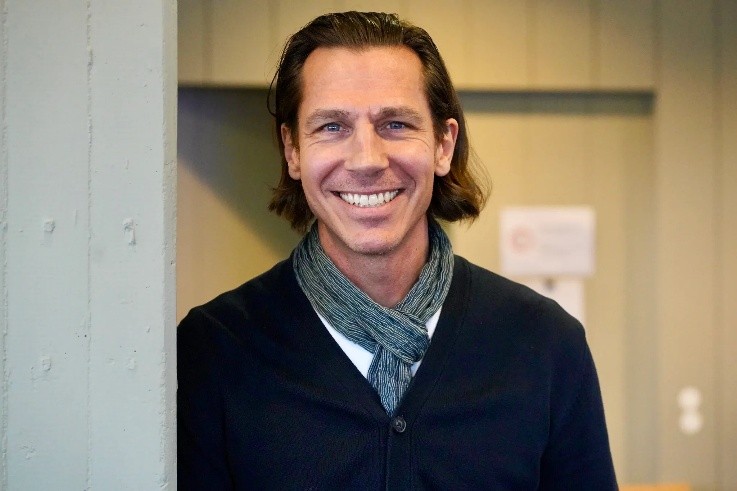
“Only Deep Tech innovations from research create real societal impact.” Dennis Albert, Professor of Marketing Management, WBS / Photo: Heike Jüngst
Albert also speaks openly about doubts along the way. “It was the most challenging seminar I’ve ever done,” he says—not only because Deep Tech sits far outside his own start-up experience, but also because the format demands a lot from students, technically and mentally.
The deep-tech challenge
Albert comes from the classic start-up world: customer needs, fast iterations, short decision cycles. Fundamental research runs differently. It’s expensive, slow, stubborn. “I had to completely re-learn the field,” he says. And he had to convince his students to engage with technologies that don’t have a market yet—and may not for years. “If we’re talking about real societal and economic impact, it only happens through Deep Tech,” Albert says. “Not the next digital product that just makes an existing need slightly more convenient.” For him, it mattered to show a different logic: meaningful change often emerges from fundamental research—not market research.
Albert credits the seminar’s success—despite initial skepticism—to close coordination with TU Darmstadt. “We deliberately decided to build everything from scratch—our own curriculum, our own templates, our own financial models.” Each session was tailored to specific technologies. “This wasn’t a generic business administration overlay,” he says. “And honestly: I had homework every single week.”

Digital Business Management Master’s students turned research ideas into tangible business models. / Photo: Dennis Albert
There were tough phases: teams stuck, doubts about whether highly complex research could yield a viable business case at all. “I pulled groups aside, sorted worries, rebuilt confidence,” Albert says. “And then everyone leaned back in.” The final pitches surprised even the researchers. “Those ten minutes on stage don’t show how much work is behind it.”
Four study cases, four ways of thinking
At the heart of the seminar were four Deep Tech cases from two TU Darmstadt departments. Two came from Prof. Andreas Blaeser (Biomedical Printing Technology, Department of Mechanical Engineering): printed, vascularized organ-on-chip systems for preclinical testing, and bioprinting technologies for sustainable meat alternatives. Students had to work with regulatory hurdles, long validation cycles, and conservative industries.
The other two cases came from Prof. Mario Kupnik (Measurement and Sensor Technology, Department of Electrical Engineering and Information Technology – etit): 3D-printed air-coupled ultrasonic transducers, and flexible ferroelectret force sensors for robotics and wearables. Here, the challenges revolve around niche markets, customization, scaling, and the question of where technological advantages can actually command a price.
Prof. Andreas Blaeser acted as a sparring partner for the teams developing business cases around his two patented innovations. “It’s exciting to see how students look at our research without technical blinders,” he says. “They ask different questions—and that’s exactly what transfer needs.” He adds: “Not every great idea becomes a start-up. But every great idea benefits from being thought through properly—end to end.”
This ambition didn’t stay abstract. It became measurable on an afternoon where analysis had to turn into decisions.
Pitch Day: the big finale
In mid-January 2026, the seven teams presented their results in TU Darmstadt’s Senate Hall. Around 60 attendees. Ten minutes per team. Business model, market, financing. “I was surprised by how clear everything was,” one listener from a research team says. No marketing fluff, no exaggeration—just structured proposals, plus 170 backup slides in the background. “Outstanding presentations across the board,” adds Michael Gaenssler: “After this event, I’m no longer worried about Germany’s future. We have incredible technology—and talented young people who can market these ideas and turn them into commercialized innovation,” the business coach says—after he had thoroughly “grilled” the students with questions following their pitches.

Überzeugte Forschende und Business-Coaches beim Pitch-Day / Bild: Heike Jüngst
For Anna Marie Brehm and Ferhat Caner, Pitch Day isn’t just the end of a seminar—it’s a shift in perspective. Both are close to finishing their Master’s and now see research, entrepreneurship, and the space between them differently. “You suddenly understand how much work sits between an idea in the lab and something market-ready,” Brehm says.
Two perspectives, one shared path forward
Since the seminar, the idea of founding a start-up feels more present for Brehm than before. “I can definitely imagine it,” she says. “But only if you truly believe in the idea—and are ready to go deep.” The proximity to research showed her where personal limits might be—and where new opportunities start.
The difference between Wiesbaden and Darmstadt? “Wiesbaden is closer to application; Darmstadt is deeper in research,” Caner says. “Each is strong on its own—together it becomes genuinely exciting.” Brehm adds: “You come from different ways of thinking, and that’s exactly how something robust emerges.”
Maybe that’s the quiet strength of this format: not every participant will become a founder. But everyone learned how translation work actually functions—between lab and market, between technology and business. And that cross-university collaboration doesn’t mean smoothing differences away—it means making them productive.
(Author: Heike Jüngst)