

More than 10,000 operational satellites currently orbit Earth, forming a global data network — a 3D Adobe Stock rendering that illustrates worldwide digital connectivity.
Bild: Adobe Stock
Darmstadt is considered Europe’s space capital. Here, in the environment of TU Darmstadt and within sight of the ESOC, a young team is working on a problem that has slowed the industry for decades: satellite data usually reaches the ground only during the next pass over a ground station. That often takes around 90 minutes — too slow for crisis teams, too expensive for operators, and too sluggish for many applications.

The founding team of Aperio Space Technologies: Valentin Henkys, Mehrsa Shirzadian, and Thomas Hoffmann (© Aperio)
Aperio Space Technologies, a TU Darmstadt startup, focuses on software. The founders Thomas Hoffmann (CEO, physicist specializing in cybersecurity, network technology, and quantum cryptography), Valentin Henkys (CTO, computer scientist specializing in high-performance computing, cryptography, and routing algorithms), and Mehrsa Shirzadian (CMO, with a background in international media and technology management, specialized in strategic communication and high-tech marketing in the space sector) are developing an architecture that integrates satellites from different operators into a flexible data network — similar to the internet on Earth, but in orbit.
The idea originated in the TU student group Space Technologies. In 2024, the Aperio team was a finalist in the TU Idea Competition in the student category. Financial support comes from the EXIST Startup Grant of the German Federal Government, the ESA Business Incubation Centre (ESA BIC), and the State of Hessen. The goal of Aperio Space Technologies is clear: data should come down wherever it is possible — and almost in real time.
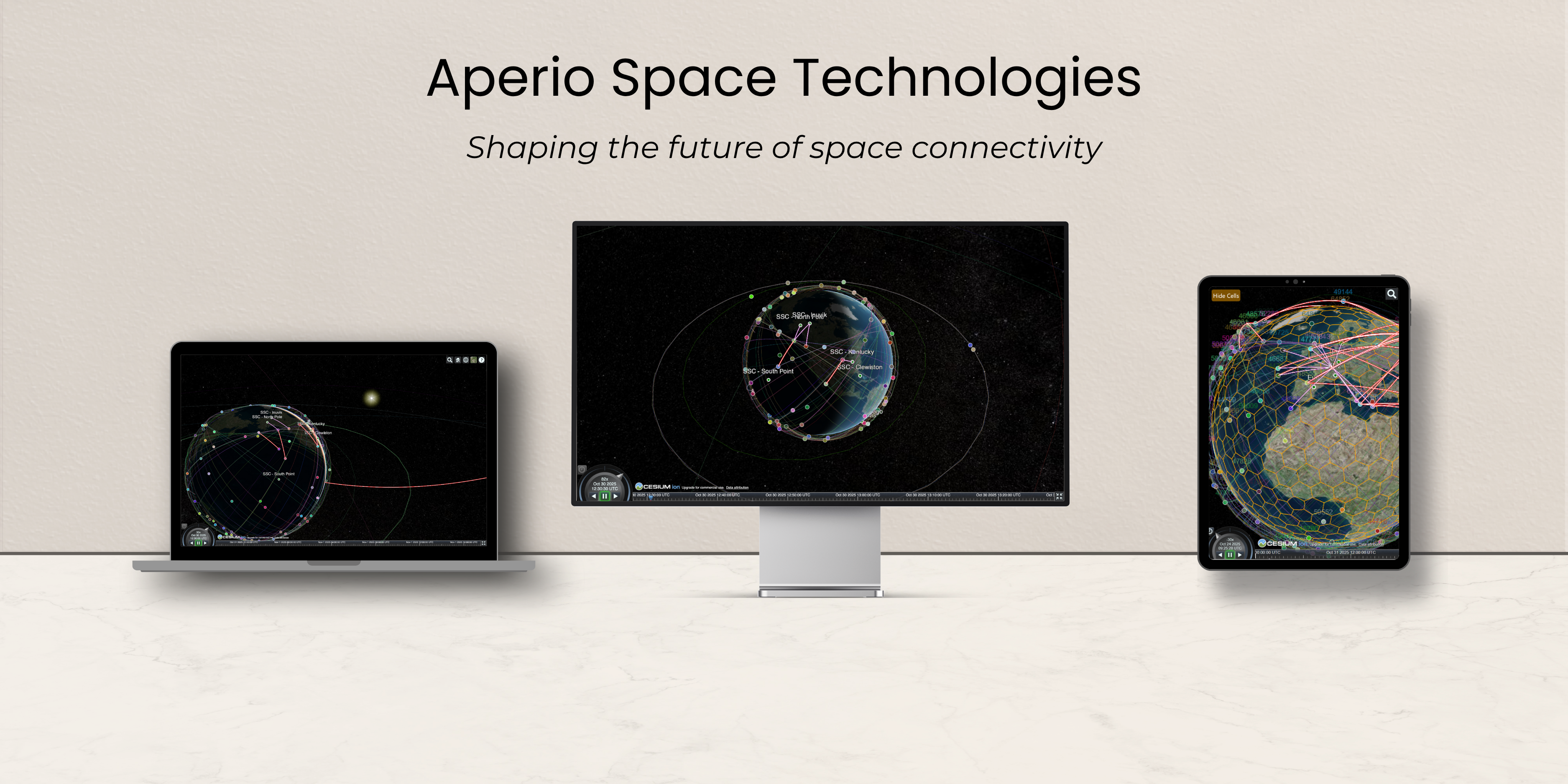
Space communication and infrastructure: Aperio Space Technologies develops software and key technologies for satellites, ground stations, networks, and telecommunications systems — in space and on Earth (© Aperio)
THE INTERVIEW
In conversation with Thomas Hoffmann, Valentin Henkys, Mehrsa Shirzadian, and Prof. Thomas Walther
HIGHEST: Thomas, what exactly does Aperio Space do, and which problem does your technology solve?
Thomas Hoffmann (CEO):We write software that helps satellites bring data to Earth faster. Instead of waiting until a satellite sees a ground station, we forward the information through other satellites — to the one that can downlink it immediately.
HIGHEST: So basically “telephone game” in space — but without misunderstandings?
Thomas:That’s a good description. Our software constantly searches for the best route in a dynamic network. It considers visibility windows, bandwidths, priorities, and security requirements. This way, measurements and images reach the ground much earlier.
HIGHEST: Why is that important?
Thomas: Because today’s processes are slow. A satellite collects data, but reaching the next ground station usually takes 90 minutes. Anyone fighting wildfires, monitoring supply chains, or stabilizing networks loses valuable time. We reduce that gap to near real time.

Thomas Hoffmann, CEO Aperio Space Technologies (© Aperio)
HIGHEST: How did you come up with this idea?
Thomas: It originated in the TU Space Technologies student group. That’s where I met Kai Wördehoff, a fellow physics student. Kai knew about the tight communication windows from the ESOC environment. We asked ourselves why satellites don’t simply relay data among each other until one has a ground station in sight. That became our concept.

Valentin Henkys, CTO Aperio Space Technologies (© Aperio)
HIGHEST: Valentin, what is the technical foundation?
Valentin Henkys (CTO): Our technology consists of three main components.
The first is a simulation and visualization tool we offer as Software-as-a-Service (SaaS). Operators can use it to plan satellite constellations, test data rates and delays, and optimize network performance in advance.
The second component is an SDN controller — a control software deployed in existing fleets. It coordinates connections and data routes between satellites in real time, ensuring stable and efficient communication.
Third, we’re developing an open network operated by us. Smaller operators can join, even if they cannot achieve global coverage alone. By pooling resources, they gain high availability. Billing is usage-based — we currently estimate around one euro per megabyte.
HIGHEST: What are the biggest technical challenges?
Valentin: The system’s dynamics. Satellites are constantly moving, which means the entire network is continuously changing. We must predict visibility windows, allocate available resources, and comply with regulatory requirements — all in real time. That’s the core of our work.

Mehrsa Shirzadian, CMO Aperio Space Technologies (© Aperio)
HIGHEST: Mehrsa, who benefits from your technology?
Mehrsa Shirzadian (CMO): Our direct customers are satellite operators and system integrators. The applications span multiple sectors.
In Earth observation — for weather and environmental data — warnings can be issued faster and decisions become more informed.
In logistics and global supply chain monitoring, the system helps create an almost real-time situational picture to manage risks better.
Telecommunications benefits as well: orbital links can close gaps in terrestrial networks and connect remote regions.
In government and defense communications, the technology enhances availability and security.
Finally, it supports space situational awareness — enabling a denser picture of orbit activity and helping prevent collisions.
HIGHEST: How do you acquire customers?
Mehrsa: Through industry trade fairs and conferences. That’s where we meet decision-makers, demonstrate simulations, and arrange pilots. Classic cold calls don’t work as well in this industry as a good conversation at a booth.
HIGHEST: Where do you stand economically as a startup?
Thomas: We’re currently pre-revenue, conducting pilots and demonstrations, and negotiating with our first customers. In parallel, we’re applying for ESA development contracts.
Funding comes from the EXIST grant (around €130,000), ESA BIC, and state funding.
We’re deliberately bootstrapping to maintain pace and direction.
Darmstadt is ideal for this: the proximity to TU and ESOC gives us access to a large, relevant network. HIGHEST supports us with business model development, funding, and partnerships. ESA BIC provides mentoring, support, and industry connections.
HIGHEST: You were finalists in the TU Idea Competition in 2024. Did that help you when founding Aperio?
Thomas: Yes. We received valuable feedback on telecom use cases, patent strategy, and customer willingness to pay. It sharpened our product–market fit.

Thomas Walther, Vice President of Innovation and International Affairs (© Aperio)
HIGHEST: Professor Walther, you mentor Aperio Space Technologies. Why?
Prof. Thomas Walther (Vice President Of Innovationen & Internationales, TU Darmstadt):I know Thomas Hoffmann from my quantum optics research group — he completed his bachelor’s thesis with me. He’s determined and persistent. When he showed me the idea, it was clear I would support it through EXIST. The project addresses a difficult communication problem in orbit. Technically demanding, but also well aligned with quantum-secure communication — I see long-term potential there.
HIGHEST: What makes you confident that this team will persevere?
Walther: Aperio’s strength is the combination of different talents. The team is persistent, flexible, ambitious, optimistic, and energetic. Those are exactly the qualities needed to build a company.
HIGHEST: Why is this concept one of the next big technologies after AI?
Walther: The number of satellites in orbit keeps increasing — partly because data is becoming ever more important in the age of AI. Communication with satellites is highly time-limited, possible only during short overflight windows. Aperio’s technology makes data upload and download far more time-efficient.
HIGHEST: Thomas, how big is your team and how is it organized?
Thomas:We currently have nine people, including the founding team. Some work full-time, others as student assistants or through thesis projects. For us, leadership means clear goals, short communication paths, and transparency. Motivation comes from everyone being able to see the direct impact of their contribution.
HIGHEST: What does the legal framework look like — specifically regarding IP and patents?
Thomas:Our intellectual property belongs to the GmbH. It was created entirely outside of university employment, so ownership is clear. This matches our vision: we want the core technology in-house to continue developing it and bring it to market through partnerships.
Cooperation with large system integrators is expressly welcome — together we can scale faster.
We’re not planning to sell the company or the patent. We’d only consider it if it helped the product and increased its impact for users.
HIGHEST: What are the next steps?
Thomas: We’re completing ongoing pilot projects and preparing our first commercial deployment. At the same time, our open network is expanding so more operators can benefit immediately. Technically, we’re strengthening interoperability and security to make the solution robust in everyday use. We’re approaching everything consistently — step by step, but quickly.
HIGHEST: Thank you for the conversation — and for the shortcuts in space.
Text and photos: Heike Jüngst