
0823
Process for the production of a porous ceramic body
Porous and nanoscale porous ceramics, such as silica, are used in membranes, chromatography columns and other applications. In established manufacturing processes, the porous structure cannot be adjusted independently across all length scales. This is a disadvantage for the optimization of material performance, e.g. with regard to separation and transport. In addition, the introduction of functional groups or polymers is only possible.
Department
Chemistry
Subject area
Makromolekulare Chemie Smart Membranes
Patent number
DE102023132480
Contact person
Prof. Andrieu-Brunsen
annette.andrieu-brunsen@tu darmstadt.de
+49 6151 16-23742
Downloads
Lorem ipsum dolor sit amet, consetetur sadipscing elitr, sed diam nonumy eirmod tempor invidunt ut labore et dolore.
Optionale Headline
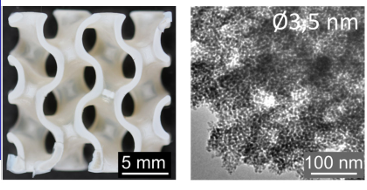
We have developed a process that allows pore structure on the nanometer scale and object shape on the micrometer and macroscopic length scale to be controlled independently of each other and also to introduce in-situ functional groups or polymers into the material. This is made possible by the combination of various light-induced reactions, light-based sol-gel chemistry and light-controlled assembly processes. The production is carried out in a 3D printing process using digital light processing. Translated with DeepL.com (free version)