IMS Xchange Workshop
IMS Team Reassesses Projects for Future Spin-offs
Two-day IMS xchange workshop at Kloster Höchst strengthens transfer skills and entrepreneurial momentum across a 30-person research group
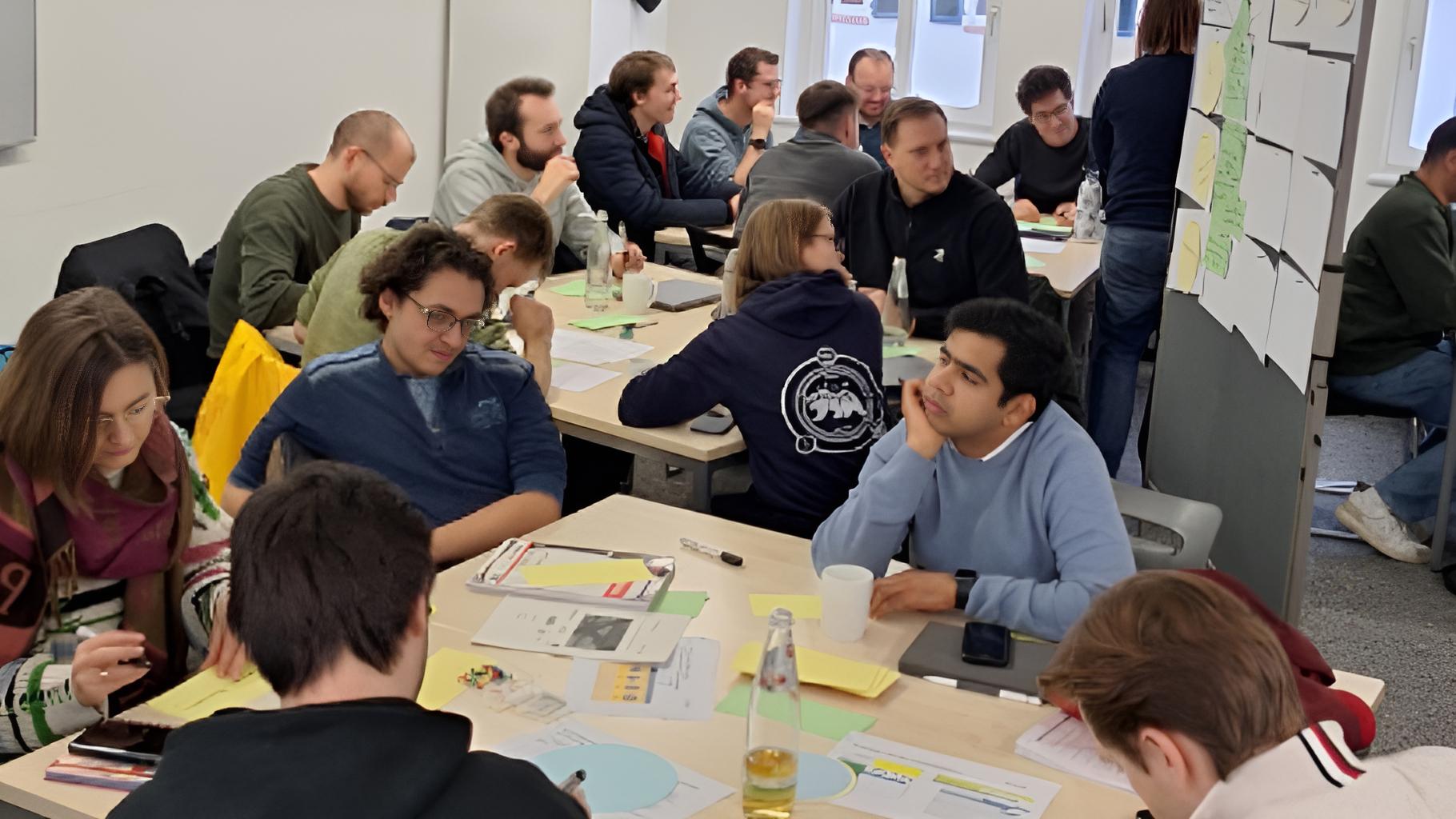
A 30-person research team at TU Darmstadt’s Institute for Mechatronic Systems (IMS) used a two-day offsite at Kloster Höchst (Odenwald region) to systematically examine the market potential of its projects—building shared transfer methods and creating early foundations for future spin-offs. The workshop was designed and facilitated by HIGHEST with support from experienced coaches, and attended by IMS Director Prof. Dr. Stephan Rinderknecht and recently appointed Prof. Dr. Debora Clever.
The retreat was initiated through TU Darmstadt’s xchange award—recognising long-standing entrepreneurial commitment within academia. Prof. Rinderknecht invested the full €5,000 prize money into the workshop, a decision that quickly set the tone: this was not a motivational talk, but a structured working format with clear expectations.

Prof. Dr. Stephan Rinderknecht
First-hand founder perspective from within IMS
The programme opened with HIGHEST introducing the xchange programme and its support pathways for transfer and entrepreneurship. It then shifted to practical insights from founders who have taken the route from research to company-building.
Stéphane Foulard, Co-Founder and CEO of IMS spin-off Compredict, shared lessons from building a technology-driven venture, highlighting recurring challenges faced by research-based teams—particularly where early technical choices later shape product feasibility, customer fit, and execution speed. Hendrik Schaede-Bodenschatz, Co-Founder of Adaptive Power Balancing, complemented this perspective with experiences from his own entrepreneurial journey. Both companies were founded in 2016 and are among IMS’s early, successful spin-offs.
Three more recent ventures—Folivora Energy, InnoShiftING, and Senexity—also introduced their work, illustrating how broadly innovation capabilities are distributed across the institute.

Stéphane Foulard, Co-Founder and CEO of the successful spin-off COMPREDICT
Structured ideation grounded in research reality
Following the opening sessions, participants moved into a guided ideation phase using a structured search-field matrix—an approach that helps teams identify promising opportunity areas at the intersection of technology strengths, application domains, and potential user needs. Concepts that began as rough sketches quickly developed into a diverse set of coherent early-stage ideas.
Structured ideation grounded in research reality
Following the opening sessions, participants moved into a guided ideation phase using a structured search-field matrix—an approach that helps teams identify promising opportunity areas at the intersection of technology strengths, application domains, and potential user needs. Concepts that began as rough sketches quickly developed into a diverse set of coherent early-stage ideas.

Hendrik Schaede-Bodenschatz
From research impulse to early business logic
Day two began with a keynote by Georg Fischer on cognitive biases in innovation processes—focusing on how decision-making shortcuts can distort opportunity assessment, especially under uncertainty. Teams then advanced their concepts using a fast, compact “Leporello” format—a one-page fold-out canvas designed to translate a research impulse into an initial business model logic (problem, target users, value proposition, and first assumptions).
The closing short pitches made the progress tangible: within hours, teams were able to communicate not only what they could build, but why it could matter—and for whom.
Beyond the offsite: methods that travel back into the institute
The workshop was marked by intensive collaboration, frank discussion, and the kind of direct feedback that academic settings often lack: experienced founders challenged assumptions, sharpened narratives, and made abstract innovation concepts practical.
The key outcome is not a single “finished” idea, but a stronger shared toolkit and a reinforced entrepreneurial mindset within the institute. Prof. Rinderknecht emphasised that both were achieved at a high level—pointing to immediate follow-on use: IMS doctoral researchers plan to apply the methods at their next off-site meeting in France, directly to their dissertation topics. “My expectations were more than met,” Prof. Rinderknecht concluded. For IMS, the workshop was far more than training; it served as a concrete impulse that brought team, research, and entrepreneurial ambition visibly closer together.
Text: Heike Jüngst
Photos: Carola Heyn-Benedikt