

From more than 120 submissions, twelve teams have made it through to the final of the TU Ideas Competition. Their ideas range from build-it-yourself robotic arms to insulation boards made from fungi, and from rescue drones to artificial skin produced on a 3D printer. Some grew out of student projects, others out of years of research. What they all share is a clear goal: to solve a real problem.
At INNODAY26 at the end of October, the six student teams and six research teams will present their projects on stage, competing for victory in their respective categories.

Team Picture fungifoam
Team Picture aerojam
Team Picture MIP-sense

Team Picture Dare Robotics

Team Picture PRIB

Team Picture Tooliip

Team Picture Nuvotis
Team Picture Modolino
The twelve ideas at a glance
Student category
DARE Robotics. To truly understand a machine, you should build one yourself at least once. With robotic arms, that has so far been almost impossible: industrial models often cost tens of thousands of euros, and learners may at most operate them – never open them up or modify them. Tim Ulrich’s team is closing this gap with ATHENE, a robotic arm you can build yourself. Its parts are 3D-printed and the blueprints are freely available, so anyone can recreate the arm. An interactive guide accompanies every step, explaining why a particular gearbox is fitted or how the controls and software work together.
FungiFoam. In most cases, insulating a house means installing polystyrene. Made from crude oil, the material keeps out the cold well, but it barely decomposes and often ends up as hazardous waste once a building is dismantled. With FungiFoam, Valentin Scheiermann’s team is growing an alternative: insulation boards made from fungal mycelium and upcycled straw. As they grow, the boards absorb more CO₂ than is needed to produce them. They insulate against cold and noise and are naturally fire-resistant. They are intended to cost no more than conventional polystyrene, so that sustainability no longer comes at a premium.
MIPsense. Levodopa is the most important drug for treating Parkinson’s disease, yet finding the right dose is difficult: its effect fluctuates throughout the day, and many patients still have to judge it by feel. Too high a dose can trigger involuntary movements, while too low a dose allows the symptoms to return. Members of the student research platform TUcanSense are therefore working with MIPsense to develop a sensor that measures the active substance directly in the body, much like a blood glucose meter for diabetes. In future, patients should be able to rely on dependable readings rather than gut feeling to adjust their dosage more precisely.
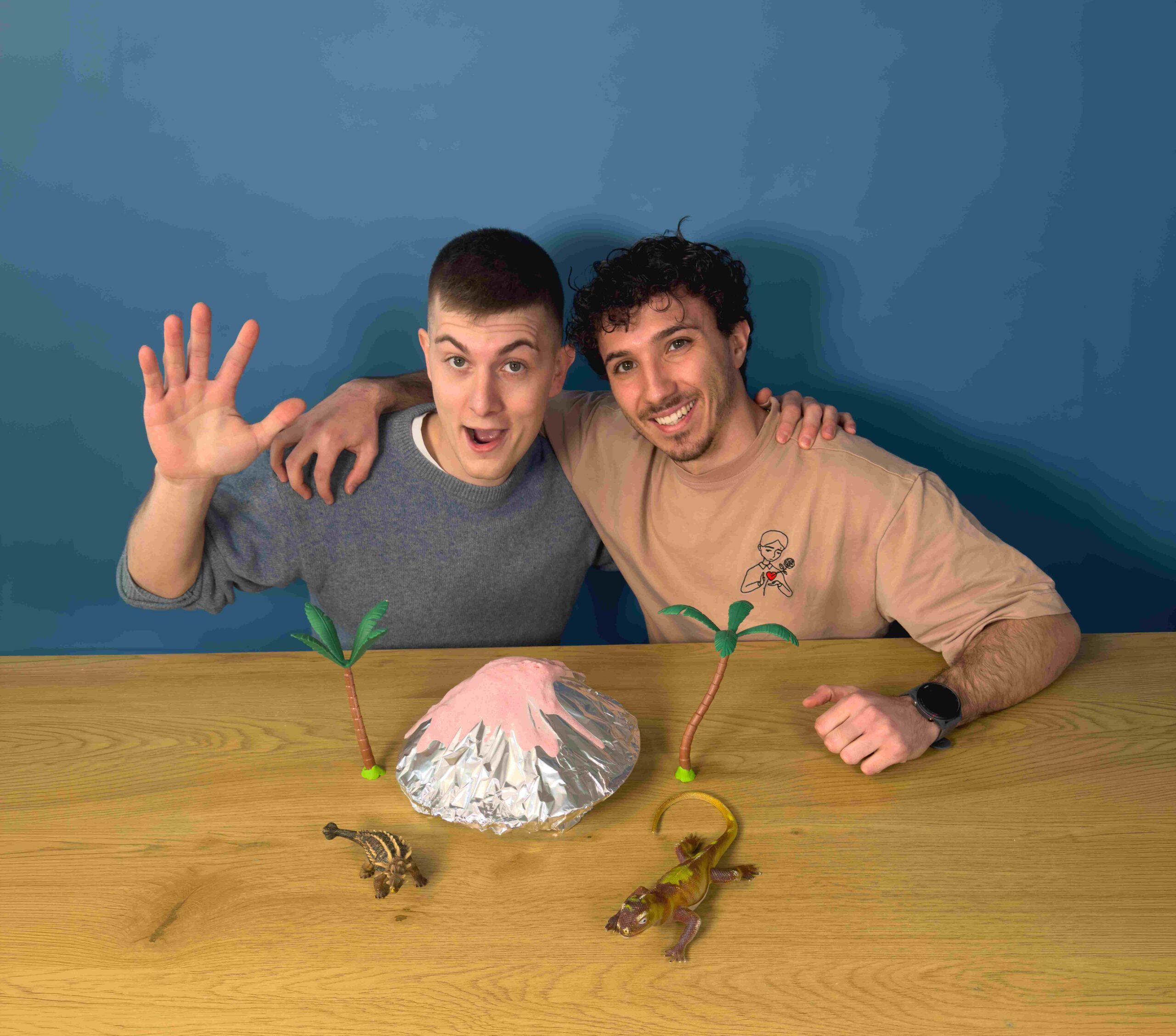
Modolino. Many children spend their free time in front of screens instead of trying things out for themselves. Using simple household items such as a bottle of vinegar and a little baking powder, Modolino turns the kitchen into a laboratory where children aged three to eight can easily carry out science experiments. Seventeen animal characters accompany them along the way, supported by free videos, instructions and research logs. Louis Rittersberger and Mateo Brecic’s idea is already used by a community of more than 100,000 families.
Ahmet Yasin Karahanci. During search operations or inspections of industrial facilities, teams often have to make their way through narrow pipes, shafts or rooms at risk of collapse. Drones are used for this too, but they have one problem: with their wide-spanning rotors, they barely fit and break easily at the slightest contact with a wall. Ahmet Yasin Karahanci has therefore developed a foldable drone with two stacked rotors. Folded up, it fits in a rucksack, and in action it can withstand collisions in confined spaces.
Programmed Morphogenetic Assembly. New cancer drugs are tested in the laboratory long before they are given to patients. Yet standard test models often fail to reflect how a real tumour is structured: it consists of many different cell types that interact closely. Mohammad Aman is therefore using Programmed Morphogenetic Assembly to develop more realistic tumour models for research. On a so-called ‘organ-on-a-chip’, different cell types arrange themselves in a controlled way into a tumour-like structure. This allows new treatments to be tested more reliably before they enter clinical trials.
Researcher category
AeroJam. In a rescue operation, every kilo the emergency responders have to carry counts. The conventional vacuum mattress gives injured people reliable protection during transport, but it is heavy and takes up a great deal of space in the ambulance. Hannes Mittwollen and Fritz Walter have therefore developed a lighter version: AeroJam. Instead of granules, it uses inflatable air chambers that mould to the body and stiffen under vacuum. This saves weight and space in the ambulance.
Mohamad Mansuri, Aymen Bekri & Fatima Khodarahmi. When the power goes out after a storm, local authorities often only find out hours later which waterworks, hospitals or mobile phone masts will fail next. The reason: electricity, water and communications are closely interlinked in cities, and a single outage often brings down other networks with it. Existing simulations take many hours to produce such forecasts. Mohamad Mansuri, Aymen Bekri and Fatima Khodarahmi have therefore developed an AI that incorporates real physical laws and delivers results in seconds. This enables local authorities, utilities and insurers to prepare more quickly for climate and security risks.
KinetiCAD. Nothing gets made on a production floor without first planning which machine will produce which part and how, how it will be clamped, which tools are required and in what order it all happens. To this day, that is done by hand – whether in a workshop with ten employees or a plant with two hundred machines. And the work is actually done twice: once to price up an enquiry, and again to manufacture the part.
Yusuf Bera Demirhan, Yaniv Sharon and Scarlett Grimes are automating this process with KinetiCAD. Their software reads a component’s 3D model, plans the entire production run on the machines available and writes the matching control programs, including a price calculation. What used to take days now takes minutes – and already at the enquiry stage, long before an order is confirmed.
Nuvotis. Before a new drug may be tested on humans, it must first prove its efficacy and safety in animals. In Germany alone, some two million laboratory animals were used in 2024. The problem is that results from animal testing cannot always be transferred to humans. That is why Louise Breideband, Levin Hafa and Francesco Pampaloni of Nuvotis print human tissue from living cells – of the skin, gut or oral mucosa, for example. The printed tissue behaves like real human tissue, making it possible to test the efficacy and tolerability of new medicines realistically on human tissue – entirely without animal testing.
PRIB. New medicines and greener industrial processes often require tailor-made proteins, such as antibodies or enzymes. But a protein that looks promising on the computer often fails in the lab because of real-world physics: it folds differently than planned or does not remain stable. In PRIB, Bingyi Zhao, Liu Haipei and Xianglong Peng therefore combine three approaches: AI-generated proposals for new proteins, physical laws that predict their stability, and real laboratory results that feed back into the model. The aim is for more digital designs to become proteins that remain stable in real life and serve as the basis for better medicines and more sustainable biotechnology.
Tooliip. Parkinson’s disease changes from day to day. As doctor’s appointments often take place only every few months, it is almost impossible to remember every detail. As a result, doctors lack important information they need to adjust treatment. Max Gudzent, Enrique Gutierrez Simoes and Wendi S. have therefore developed Tooliip, a voice assistant for people with Parkinson’s, drawing on their own family’s experience of the disease. Those affected simply talk about how they are feeling. Over time, the AI recognises patterns and uses them to compile a structured report for the next appointment.
The winners will be decided at the end of October at INNODAY26, where all twelve teams will take to the stage live once more.
Editor: Heike Jüngst