Sucess Story
February 26, 2026
Light for Health and a Better Mood
Sunlight governs a wide range of processes in the human body. To make these benefits available during the dark winter months, the start-up akaris is developing a mask that recreates key properties of daylight—aiming to boost wellbeing and performance in a short time, and to support people coping with shift work and jet lag.
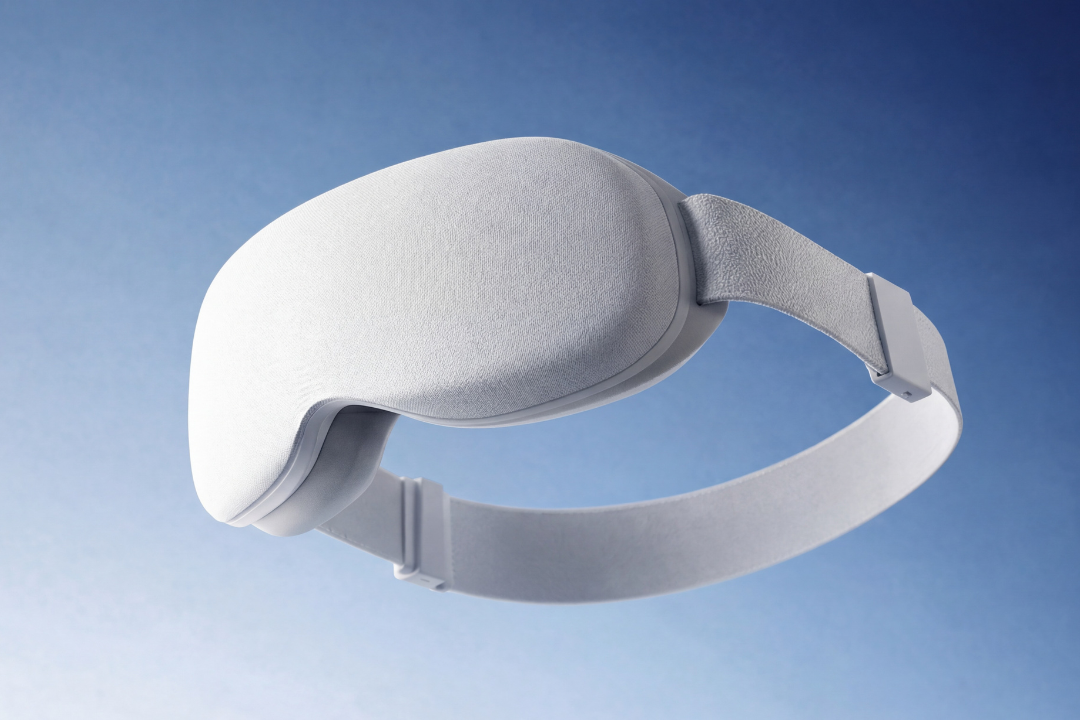
Innovative mask for simulating sunlight and regulating bodily processes during shift work and jet lag
Sunlight governs a wide range of processes in the human body. To make these benefits available during the dark winter months, the start-up akaris is developing a mask that recreates key properties of daylight—aiming to boost wellbeing and performance in a short time, and to support people coping with shift work and jet lag.
Jens Balasus, one of akaris’ two founders, hands me what looks like a pair of ski goggles. Even though we are sitting in a well-lit office, my eyes need a moment to adjust to the glaring “daylight” inside the mask. A bright sky arches overhead—the sensation is reminiscent of a VR headset. In fact, the sun is only just “rising”: at least that is what the scene inside the goggles imitates. Over time, the display transitions into a clear blue summer sky. “When you’re lying on your back, it’s like being out on a meadow, looking into the distance,” says akaris co-founder Alexander Herzog.
That sense of wellbeing, the two founders explain, has a scientific basis. “At the Chair of Adaptive Lighting Systems and Visual Processing, we also work on the health-related components of light,” they say. Like all living organisms, humans are strongly aligned with a day–night rhythm—reflected in performance curves and our need for sleep at night. The key control mechanism is daylight, which regulates our activity cycle via the body’s own hormones such as melatonin and serotonin, and through a multitude of biochemical processes. “But we spend around 90 percent of our time indoors, where natural light can barely steer our internal clock,” Herzog says.

The akaris founders Alexander Herzog and Jens Balasus. © akaris
Daylight as a Health Factor
Even modern indoor lighting systems emit only parts of the sun’s spectrum, the lighting engineers explain. Daylight-like illumination requires not only a combination of many specific wavelengths, but also a defined illuminance—i.e., the luminous flux falling on a surface. For more than seventy years, the Chair of Adaptive Lighting Systems and Visual Processing at TU Darmstadt has researched the interdisciplinary effects of light on human health, including harmful influences such as UV radiation. “You tend to notice the positive effects of light on the body over the long term—and they are used surprisingly little,” Herzog says. The two scientists, who worked at neighboring desks, decided to change that.
The initial idea emerged during a lunch break. “We had LED panels with a production defect that reproduced a natural sky gradient,” they recall. They found the effect aesthetically appealing and strikingly natural—prompting them to think about how it could be applied deliberately. A lack of sufficient daylight in winter is a common issue, yet it is crucial for preventing sleep disorders, fatigue, and the winter blues, and for reducing the effects of shift work and jet lag. Daylight lamps do exist, Balasus notes, but they are often not used at the necessary close distance. Drawing on their LED expertise and their scientific understanding of how light affects humans, the two developed the concept of a “light mask.” “We want to make the positive effects of light easily accessible,” Balasus says. The name akaris is derived from the Japanese akari (明かり), meaning light.
“I always wanted to start a company,” Herzog says. They found inspiration at INNODAY and similar events hosted by HIGHEST. “We want to make our research insights accessible through innovative products.” After all, who knows that dim green light may help with migraines, that red light can support retinal regeneration, or that certain types of light flicker may influence Alzheimer’s? The first version of the mask was still somewhat bulky—but test users were enthusiastic. “Family and friends were immediately convinced—and even HIGHEST’s advisor didn’t want to take the mask off,” Herzog recalls. Fifteen minutes a day—or two sessions of ten minutes—can deliver a tangible energy boost. “Afterwards I’m awake and focused,” Balasus says. Herzog adds: “It can demonstrably optimize performance before competitions as well.”
Relaxation—Like Being on Holiday
The sense of horizon and distance relaxes the eyes. “We simulate sunrise and sunset, all the way to a blue sky,” Balasus explains, describing how the visual presentation changes. Herzog sketches the wavelength distribution of conventional LED lights, which typically show a pronounced gap in the spectrum. “That spectral gap can be a problem for the human circadian clock in winter,” he says. Thanks to their expertise, they can reproduce the visible portion of the daylight spectrum with high precision—without harmful UV radiation or blue-light damage. A follow-up model is more compact and features a more refined design. Since the start of the year, product designer Erika Martinez Duque has been supporting the team. The next target is to produce a modern lifestyle wearable; certification as a medical device would be expensive and time-consuming.
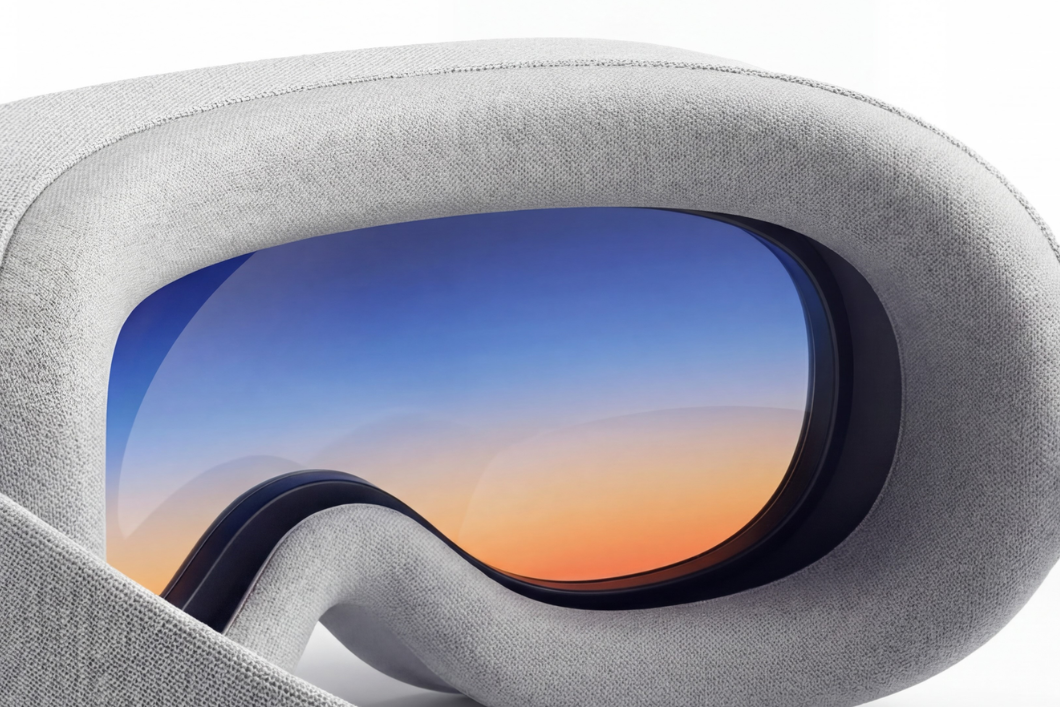
Together with HIGHEST, the team applied for an EXIST start-up grant last year—and succeeded. Since November 2025, three positions have been funded, alongside material resources and coaching. A further advantage of EXIST is its contractual connection to the university. The head of the chair, Professor Tran Quoc Khanh, enables akaris to use laboratories and supports the work with studies. The company has recently filed a patent application for the mask’s technology: users do not see a uniformly glowing surface—“that would feel like dense fog or a snowstorm, because you lose orientation,” Herzog explains—but a structured “sky” with a sense of depth. This is achieved through specially arranged and selected light sources paired with matching optics. With a bright white mask and uniform background, the eyes would constantly strain to find a reference point or pattern.
The immediate goal is to further develop and test the prototype. The final design is scheduled for completion in summer, after which production is expected to begin—so the product can reach the market by next winter. At present, the akaris team is building its production chain and evaluating manufacturing options in Europe and internationally. Ideally, they would like to produce in Europe—“but we need to assess what’s realistic,” they say.
Wellness, Sport, and Senior Care Homes
The founders see strong demand for the mask as a lifestyle product—specifically for improving performance, optimizing sleep, and boosting mood and energy in winter. Following feedback on the prototype, the focus is now on marketing. For follow-on financing, akaris is currently exploring different options. “We want to be able to make a living from this,” the inventors say confidently. Via a web shop—potentially with partners in wellness and sports—the mask is intended to reach a broad audience. Beyond fitness, the team is also focusing on people who, for professional reasons, must cope with changing day–night rhythms. “And people in senior care homes often suffer from sleep and rhythm disorders because they don’t get enough direct daylight,” Balasus adds. Further studies in cooperation with TU Darmstadt are expected to open up additional applications.
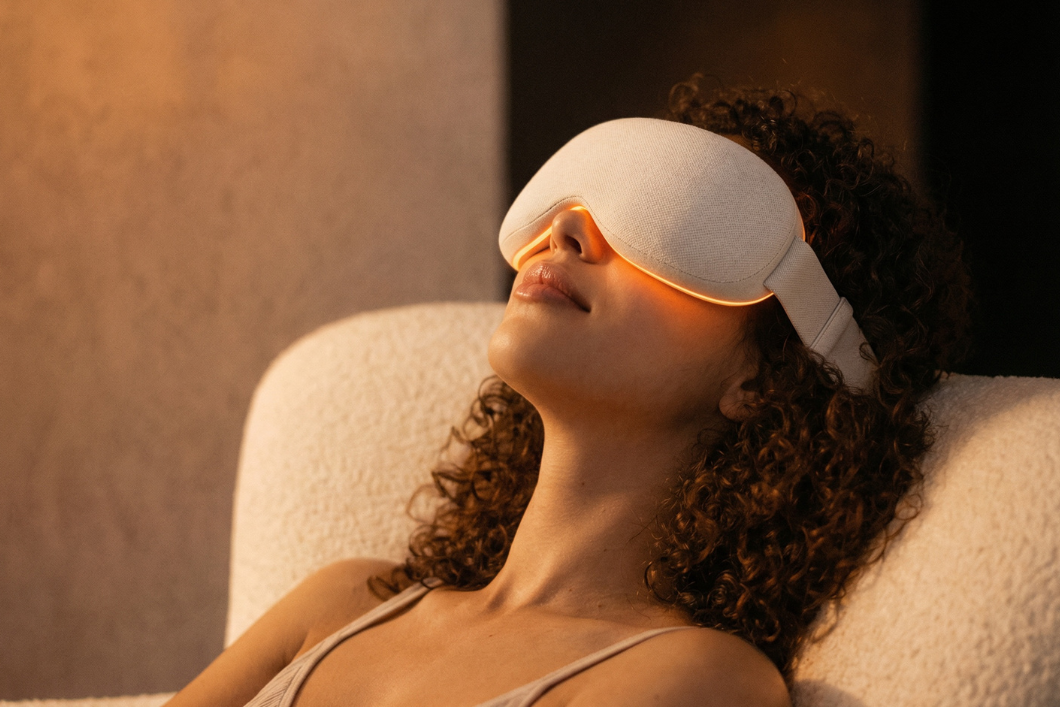
akaris expects particularly strong demand from people experiencing the winter blues—an issue that up to one fifth of the population complains about, especially in northern regions. Expansion into Scandinavia is therefore on the agenda. An app is set to be available from the outset, offering visual experiences such as “sunrise in Egypt,” as well as breathing exercises and meditation. “We want to make the positive sides of light accessible,” Balasus says. “In the long term, we want to become the leading company for light interventions,” Herzog adds, describing their big ambition. Rather than merely tracking vital data like conventional fitness watches, akaris aims to actively influence—and optimize—sleep, performance, and wellbeing.
As I leave the well-lit office after our conversation, the winter sun and blue sky outside make me smile: in its natural form, this mood booster still works remarkably well.
Text: Anja Störiko
Images: akaris